Invasive Plant Project
Integrated weed management on the Upper Missouri — prevention first, then the right combination of cultural, physical, biological, and chemical tools.
Why manage invasive plants?
Between Holter Dam and Cascade, river users encounter knapweed, toadflax, leafy spurge, houndstongue, whitetop, and Canada thistle at fishing access sites, along riverbanks, and across the islands. Left alone, these plants displace the native vegetation that holds the banks together and feeds the wildlife that depends on this corridor.
In Montana, managing designated noxious weeds is not optional — it is the law, and the responsibility falls to every land manager and landowner.
- Destroy wildlife habitat and displace threatened and endangered species
- Reduce plant and animal diversity across the watershed
- Disrupt waterfowl and migratory bird flight patterns and nesting habitat
- Reduce recreation opportunities on the river and its access sites
- Cost private landowners millions of dollars in treatment and lost productivity
Noxious, obnoxious, and what the law actually requires
Noxious weeds
Designated by a regulatory agency. By law, land managers and landowners must manage these plants.
Obnoxious weeds
Plants that can invade a site but are not considered enough of a threat to merit regulation — the common dandelion, for example.
Montana Department of Agriculture priority classes
Not present, or very limited presence in Montana — yellow starthistle, dyer's woad, common reed, medusahead. Management requires eradication if detected, plus education and prevention.
Limited presence in Montana — knotweeds, purple loosestrife, rush skeletonweed, Scotch broom, blueweed. Management requires eradication or containment, plus education.
Common in isolated areas of Montana. Management requires eradication or containment where less abundant, prioritized by local weed districts.
Abundant in Montana and widespread in many counties. Management requires eradication or containment where less abundant, prioritized by local weed districts. Most of the corridor's target species fall here.
Not noxious, but regulated — plants that can still cause significant negative impacts, such as cheatgrass.
Know what you're looking at
Identification is the first step in any weed management plan. These are the species UMOWA and its partners target along the Missouri and Smith Rivers.
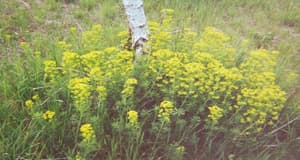
Leafy Spurge
Euphorbia virgata
Perennial- 1–4 ft tall with narrow leaves and yellow-green bracts often mistaken for flowers. Aggressive growth, extensive roots, and toxic milky sap.
- Reproduces from crown and root buds or by seed — up to 140 seeds per stem, ejected as far as 15 ft from the parent plant.
- Seeds stay viable up to 10 years; roots reach 15–30 ft deep and 15 ft wide.
Spotted Knapweed
Centaurea stoebe
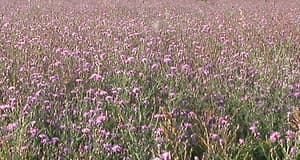
Perennial (3–9 years)- 2–5 ft tall, forming dense stands from a stout taproot with hairy, rough, sometimes woolly stems.
- First-year basal rosette of deeply lobed grayish-green leaves; second-year branched stems with pink to purple thistle-like flowers.
- Reproduces only by seed — thousands per plant, viable up to 7–8 years.
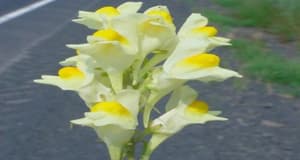
Yellow & Dalmatian Toadflax
Linaria spp.
Perennial- Erect, smooth stems 7–35 in tall with yellow snapdragon-like flowers blooming June through fall.
- Yellow toadflax has narrow, stalkless, gray-green leaves; Dalmatian toadflax has broad heart- or egg-shaped leaves clasping the stem.
- Spreads by seed and creeping root fragments; roots reach 4–10 ft deep, and both species regenerate from root pieces.
Whitetop (Hoary Cress)
Lepidium draba
Deep-rooted perennial- Invasive mustard up to 2 ft tall with lance-shaped, grayish-blue leaves and dense clusters of small four-petaled white flowers.
- Each stem can produce 1,200–4,800 seeds in inflated, heart-shaped pods; seeds remain viable 3–4 years.
- Rhizomes spread 12–30 ft. Contains glucosinolates that are toxic to cattle.
Canada Thistle
Cirsium arvense
Perennial- 1–5 ft tall with grooved stems and oblong, spiny-edged leaves; purple, pink, or white flowers from midsummer to early fall.
- Each plant produces 1,500–5,300 seeds that stay viable 20–30 years.
- Roots grow 6 ft deep and 15 ft horizontally, with rhizomes that push up new shoots.
Houndstongue
Cynoglossum officinale
Biennial to short-lived perennial- Rosette the first year, then a 1–4 ft erect stem with reddish-purple drooping flowers. Toxic to livestock — contains pyrrolizidine alkaloids that damage the liver.
- Barbed nutlets cling to fur, wool, and clothing, earning the names “beggar's lice” and “sheep bur.”
- Seed-only reproduction — up to 2,000 seeds per plant, viable 2–3 years, from a woody taproot 3–4 ft deep.
Also found in the watershed
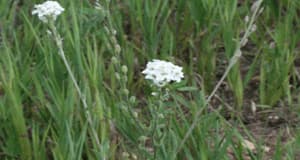
Hoary Alyssum
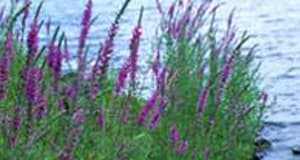
Purple Loosestrife
Integrated Weed Management
Integrated Pest Management (IPM) — applied to weeds, Integrated Weed Management — is a strategy to prevent and suppress pests with minimum impact on human health, the environment, and non-target organisms. First discussed in 1959 as a way to reduce reliance on pesticides, it starts with preventing problems rather than reacting to them.
1. Inspect, identify, monitor
Walk the ground over time — especially areas susceptible to invasion or recently treated. Identify what's present and track it. Monitoring is what tells you the extent of the problem.
2. Decide if treatment is needed
Act once weeds begin to impact management objectives. Then choose one tactic — or a combination — to hold populations at acceptable levels.
3. Evaluate and adjust
After treatment you should be able to answer “Did it work?” If not — seedbank rebound? agents failed to establish? — revise the strategy and try again.
The four treatment tactics
No single tool solves a weed problem. Each works on a different timescale, and the right program combines them.
Cultural
A key component of prevention.
Soil care, revegetation, grazing, sanitation, and minimizing disturbance keep desirable plants vigorous — and healthy plants resist invasion. You won't see dead target weeds; you'll see more desirable vegetation and suppressed weeds.
Physical / Mechanical
Works preventatively, with immediate results.
Pull weeds by hand or hoe, mow to prevent flowering, and remove flower heads to stop seed set. You see results immediately — but those results may not last.
Biological
Slow, durable suppression.
Use natural enemies — including the host-specific agents of classical biocontrol — to keep weed populations down. Results aren't readily apparent and work over years, so monitoring is key to recognizing success.
Herbicide
Fast, but not a root-cause fix.
Impact is visible in days to weeks, but treatment often must be repeated as new weeds germinate or damaged plants resprout. It does not address why the landscape is susceptible, and it requires careful consideration of non-target effects.
Scope of treatment
Monitoring defines the extent of the problem, and treatment should match it — especially when using an herbicide that affects desirable species. Spot-treating individual weeds is often more effective than a blanket application.
Timing of treatment
Treat when it will actually affect the weed, but before the weed has caused unacceptable damage. Revisit treated sites to confirm populations haven't rebounded, and be prepared to re-treat — or, for biocontrol, to re-release if agent numbers are low.
What that looks like on the Upper Missouri
UMOWA's project area covers 35 miles of river corridor from Holter Lake to Cascade, plus 3 miles up the Dearborn River and 12.5 miles up Stickney Creek — roughly 55,000 acres and 16 fishing access sites, 79% of it privately owned. The program is funded in large part by Montana's Noxious Weed Trust Fund and delivered with county weed districts, agency partners, contractors, and landowners.
Prevention & education
Early detection and rapid response, landowner meetings, and outreach to fly shops, guides and outfitters, outdoor retailers, and youth groups up and down the corridor.
Targeted treatment
Island and bank treatment by raft and backpack sprayer above the high-water mark, plus UTV, aerial and drone application, with buffers along banks, under trees, and where leaching is a concern.
Biological control
Leafy spurge flea beetles (Aphthona nigriscutus, A. lacertosa, A. flava) and the red-headed stem borer (Oberea erythrocephala) released, monitored, and redistributed across infested sites.
Revegetation
Native seed mixes from the USFS IPNF Coeur d'Alene Nursery — mountain brome, Sandberg's bluegrass, bluebunch wheatgrass, Idaho fescue, blue and Great Basin wildrye, with sterile wheatgrass to hold ground against cheatgrass.
Monitoring: how we know whether it worked
UMOWA has established permanent Standardized Impact Monitoring Protocol (SIMP) plots on the corridor — at Yetter, Blue Jay Road, and Eagle Island — installed with USFS Forest Health Protection. Each plot is a permanent 20-meter transect where crews record percent cover by vegetation class in Daubenmire frames, count leafy spurge stems and measure their height, and sweep-net for biocontrol agents. Repeated annually, that data shows whether weed populations are actually declining and whether desirable vegetation is returning. Field records and new invasives are logged to EDDMapS West, and treated areas and infestations are mapped in ArcGIS.
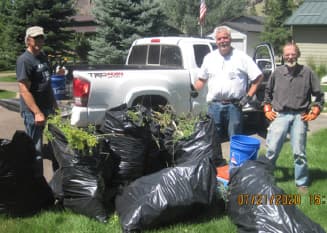
Weed Pulling in Action
Hand-pulling is the physical tactic in the toolbox — UMOWA board members and volunteers head to the riverbanks to pull weeds before they can seed and spread. A single afternoon can fill a truck bed with bagged invasives, keeping them out of the watershed and away from native plant communities.
Every volunteer hour translates into fewer weeds next season and healthier ground along the Upper Missouri.
Educational resources
Presentations, field reports, and reference material on integrated weed management along the Missouri and Smith Rivers.
From UMOWA
- 2026 Noxious Weed Educational Gathering presentationIdentification, the Montana priority system, and the full integrated weed management framework
- 2025 SIMP report — leafy spurge biocontrol monitoringPlot-by-plot vegetation and biocontrol agent data
- 2024 Smith River biocontrol & island monitoring trip reportUSFS Forest Health Protection, Carol Randall
- 2024 bioassay report & native seed mix proposalGreenhouse germination trials behind the revegetation mix
- UMOWA weed management program — Bluebird DriveTarget weeds, biocontrol agents, herbicides, and revegetation for a single roadside program
- 2025 Missouri River island weed management reportAnnual treatment results from West River Land Management
Every UMOWA weed report, island report, and grant presentation lives in the full report archive.
Elsewhere
- NAISMA biocontrol resourcesFact sheets on invasive plants and host-specific biological control agents
- Montana Department of Agriculture — Noxious Weed ProgramThe official state noxious weed list and priority classifications
- EDDMapSReport and map new invasive plant sightings in the field
- Montana Weed Control AssociationCounty weed district contacts and landowner assistance programs
Help Fund This Important Project
Your donation supports the fight against invasive species in the Upper Missouri watershed.